
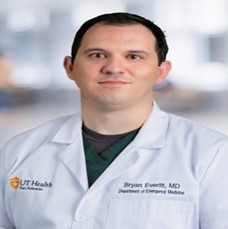
Bryan Everitt, MD, NRP, FAAEM, FAEMS, is an Assistant Clinical Professor at the University of Texas Health San Antonio (UTHSA) where he is faculty for the EMS Fellowship. Dr. Everitt currently serves as the Central Texas Regional Medical Director for Allegiance Mobile Health. Additionally, he holds the position of Medical Director for several fire departments, including Bexar County Emergency Service Districts 9, 10, 11, and 12, as well as the City of Converse Fire Department, City of Windcrest Fire Department, Bexar County Sheriff’s Office, and TEXSAR.
Dr. Everitt is originally from Charleston, SC. He served as a firefighter/paramedic with the Awendaw Fire Department, Isle of Palms Fire Department, and Mount Pleasant Fire Department. He completed his undergraduate studies at The Citadel: The Military College of South Carolina, followed by his medical education at the University of South Carolina School of Medicine. After completing his Emergency Medicine Residency and EMS Fellowship at UTHSA, he relocated to San Antonio, TX.
With over 20 years of experience in EMS, Dr. Everitt has established himself as a leader in prehospital medicine, frequently presenting topics such as prehospital sepsis recognition and treatment, heat stroke, and injury prevention. He has served nationally and is the immediate past chair of the EMS section of the American Academy of Emergency Medicine (AAEM) as well as the Treasurer of the Texas Chapter of the National Association of EMS Physicians (NAEMSP).
As an EMS physician and medical director, Dr. Everitt plays a crucial role in supporting out-of-hospital providers in their preparation for traumatic events. He advocates for resilience, normalizes mental health discussions, and promotes healthy lifestyle modifications. With his unique understanding of the challenges faced in emergency medical response to particularly traumatic events.
In his presentation, Dr. Everitt will share insights from significant events he has experienced, including the largest human smuggling incident in history and the Uvalde School Massacre. He will discuss the impact these situations had on his mental health and how they influenced his approach to EMS Medical Direction. The presentation will cover immediate response strategies, the pathophysiology of the stress response, and how EMS leaders should collaborate with EMS Medical Directors to plan for and respond to these stressors. Additionally, he will explain how he has adapted his approach to be more open and transparent about the stresses of the job, and how EMS Medical Directors can contribute to building resilience within their organizations.